
Executive Leadership Training Seminars: A Guide for Senior Leaders
First published: 25 September 2026
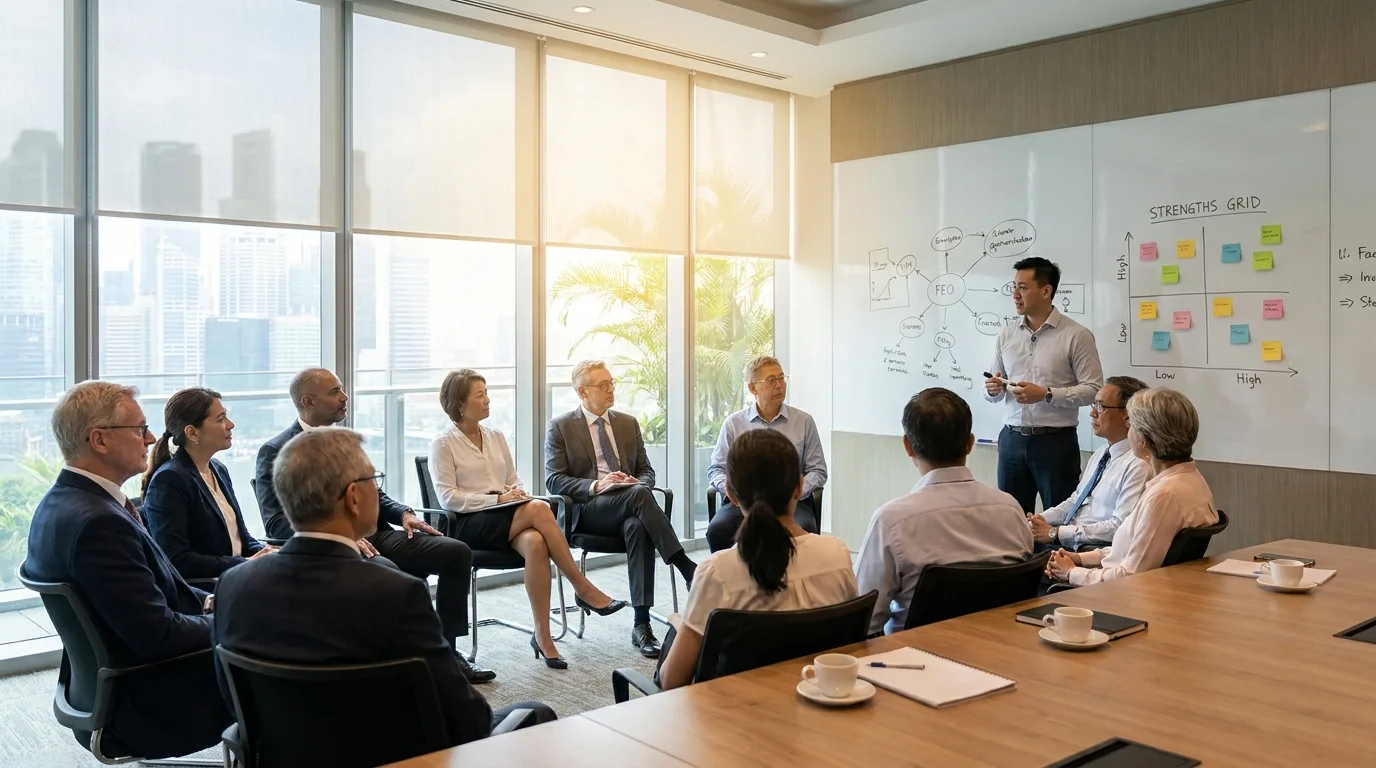
Senior leaders rarely fail because they lack technical ability. They stall because the skills that got them promoted, deep expertise and personal drive, are not the skills that scale a team or an organisation. Executive leadership training seminars exist to close that gap. They give experienced leaders a structured space to sharpen judgement, influence, and the way they get results through other people. This guide explains what these seminars cover, the formats you will come across in Singapore, and why a strengths-based approach tends to make the learning stick long after the room clears.
Quick Answer: What Are Executive Leadership Training Seminars?
Executive leadership training seminars are structured, cohort-based programmes that develop the strategic, interpersonal, and decision-making skills of senior leaders. They usually run over one to five days, in person or online, and combine frameworks, case discussion, peer coaching, and personalised assessment so leaders can lead teams and organisations with more clarity and impact.
What Executive Leadership Training Seminars Actually Cover
A good seminar is not a lecture on leadership theory. It is designed around the decisions a senior leader has to make on a Monday morning. The best executive leadership training programs concentrate on a handful of high-leverage areas rather than trying to teach everything at once.
Most cover four broad themes. The first is strategic thinking: moving from reacting to daily fires towards setting direction, prioritising, and making decisions under uncertainty. This is the area our own strategic leadership training breaks down in detail, and it is often where operational managers stumble when they step up.
The second is influence and communication. At senior level, you get very little done by direct instruction. You get it done by aligning people who do not report to you, reading a room, and communicating a decision so that people commit rather than merely comply.
The third is people and team development: coaching direct reports, building a bench of future leaders, and having the difficult conversations most leaders avoid. The fourth is self-awareness: understanding your own default patterns, blind spots, and triggers, because a leader who does not know how they show up under pressure will keep repeating the same mistakes at a larger scale.
Senior leadership training and ceo leadership training add a further layer on top of these: enterprise-level topics such as culture, board dynamics, succession, and leading through change. The higher you sit, the more the seminar shifts from managing tasks to shaping the environment other people work in.
The Common Formats You Will See
There is no single shape for an executive seminar. Formats vary by depth, time commitment, and how tailored the experience is. The table below maps the options you are most likely to encounter in Singapore.
<table style="width:100%; border-collapse:collapse; font-family:Arial, sans-serif; font-size:15px; margin:24px 0;"> <thead> <tr style="background:#1a1a2e; color:#ffffff; text-align:left;"> <th style="padding:12px; border:1px solid #dddddd;">Format</th> <th style="padding:12px; border:1px solid #dddddd;">Typical Length</th> <th style="padding:12px; border:1px solid #dddddd;">Best For</th> <th style="padding:12px; border:1px solid #dddddd;">Trade-off</th> </tr> </thead> <tbody> <tr style="background:#f7f7fb;"> <td style="padding:12px; border:1px solid #dddddd;">Short primer / masterclass</td> <td style="padding:12px; border:1px solid #dddddd;">90 minutes to half a day</td> <td style="padding:12px; border:1px solid #dddddd;">A single sharp topic or a leadership offsite opener</td> <td style="padding:12px; border:1px solid #dddddd;">Awareness, not lasting behaviour change</td> </tr> <tr> <td style="padding:12px; border:1px solid #dddddd;">Intensive workshop</td> <td style="padding:12px; border:1px solid #dddddd;">1 to 2 days</td> <td style="padding:12px; border:1px solid #dddddd;">Intact senior teams working on real challenges together</td> <td style="padding:12px; border:1px solid #dddddd;">Needs follow-up to embed the habits</td> </tr> <tr style="background:#f7f7fb;"> <td style="padding:12px; border:1px solid #dddddd;">Multi-module programme</td> <td style="padding:12px; border:1px solid #dddddd;">3 to 6 months, spaced sessions</td> <td style="padding:12px; border:1px solid #dddddd;">Structured development of a leadership cohort</td> <td style="padding:12px; border:1px solid #dddddd;">Higher time and budget commitment</td> </tr> <tr> <td style="padding:12px; border:1px solid #dddddd;">Seminar plus coaching</td> <td style="padding:12px; border:1px solid #dddddd;">Workshop anchored by 1-to-1 sessions</td> <td style="padding:12px; border:1px solid #dddddd;">Individual leaders who need tailored follow-through</td> <td style="padding:12px; border:1px solid #dddddd;">Most resource-intensive option</td> </tr> </tbody> </table>
Delivery is usually offered in three modes: in person, live online, and hybrid. In person tends to win for the group and peer-coaching work that senior development relies on, while live online suits leaders spread across markets. The one format worth understanding on its own is coaching, because it is the private, ongoing complement to a group seminar. Our guide on what executive coaching is and why it matters explains where one-to-one coaching earns its place alongside a cohort programme.
Why the Best Programmes Are Built Around Strengths, Not Fixes
Here is the trap most executive development falls into. It diagnoses what a leader is bad at, then spends the seminar trying to file down those weaknesses. The problem is that senior leaders are already accomplished. Sanding a strong leader into a rounder, blander version of themselves tends to produce a competent leader nobody follows.
A strengths-based programme starts from a different premise: that people grow fastest and lead most authentically when they build on what they are already wired to do well. Instead of asking a leader to become someone else, it asks how they can apply their natural talents more deliberately, and how they can partner around the gaps rather than agonise over them. We unpack this philosophy fully in our piece on strengths-based leadership, and it is the reason our seminars use the CliftonStrengths assessment as their spine.
The practical difference shows up in the room. When each leader arrives with their own strengths profile, the conversation stops being generic. A leader high in Command learns why they steamroll a quieter colleague high in Harmony, and what to do about it. A cohort learns to read one another's wiring and complement it rather than clash with it. That personalisation is what turns a pleasant workshop into a change that outlasts the day. It is also why strengths fluency has quietly become a core executive competency, a case we make in strengths intelligence, the new executive skill every modern leader must master.
How to Choose the Right Executive Leadership Training Programme
With dozens of executive leadership training programs in Singapore, the differences that matter are not always the ones on the brochure. A few questions cut through the noise.
Is it built for your level? A seminar designed for first-time managers will underwhelm a senior team, and vice versa. Ask who the programme is actually built for and check the examples match your reality.
How personalised is it? Generic content dates quickly. Programmes that begin with a real assessment, whether a strengths profile, a 360, or a behaviour questionnaire, can tailor the discussion to the people in the room rather than an imaginary average leader.
Who is facilitating? The quality of an executive seminar rises and falls on the facilitator. Look for someone who has led at a senior level themselves and can challenge a room of experienced leaders without losing them.
What happens after day one? Awareness fades fast. The programmes worth paying for build in follow-through, whether that is spaced modules, application tasks, or coaching, so new behaviour has a chance to become habit.
Is it customised to your context? Off-the-shelf content rarely lands with a specific senior team. The strongest providers adapt the material to your industry, your team's dynamics, and the goals you are actually trying to hit.
Answer those five honestly and the shortlist tends to shrink quickly. The right programme is rarely the longest or the most famous. It is the one whose format, facilitation, and follow-through fit the leaders you are trying to develop.
Bringing It Together
Executive leadership training seminars work best when they treat senior leaders as the capable people they already are, and give them a structured, personalised way to lead better through others. The format matters, the facilitator matters, and the follow-through matters. But the deepest lever is the philosophy underneath it all: whether the programme tries to fix leaders or build on what makes them effective in the first place.
If you are weighing up executive development for yourself or your leadership team, it is worth exploring a strengths-based leadership approach before you commit to any programme. Understanding how your team is naturally wired is the fastest way to decide what kind of seminar will actually move the needle, and to make sure the investment produces leaders your people genuinely want to follow.
Ready to develop your senior leaders around what they do best? Explore Strengths School's CliftonStrengths leadership workshops and speak to our team about a programme built for your executive team.
Frequently Asked Questions About Executive Leadership Training Seminars
What is the difference between executive leadership training and executive coaching?
Executive leadership training seminars are usually group, cohort-based programmes that develop a defined set of leadership skills through frameworks, discussion, and peer learning. Executive coaching is a private, ongoing, one-to-one relationship tailored to a single leader's goals. Many leaders use both: a seminar to build shared skills, and coaching to apply them to their specific situation.
How long do executive leadership training programmes usually last?
Formats range from 90-minute primers and one to two day intensive workshops to multi-module programmes spread over three to six months. Shorter formats raise awareness, while longer, spaced programmes are better at embedding lasting behaviour change because they give leaders time to apply what they learn between sessions.
Are executive leadership seminars worth it for experienced senior leaders?
Yes, when they are pitched at the right level. The most useful programmes for senior leaders and CEOs focus less on task management and more on strategy, influence, culture, and self-awareness. A well-designed seminar gives experienced leaders honest feedback and a structured space to work on the higher-order challenges that rarely get attention in the daily rush.
What makes a strengths-based leadership seminar different?
A strengths-based seminar develops leaders by building on their natural talents rather than trying to correct their weaknesses. Using an assessment such as CliftonStrengths, each leader receives a personalised profile that shapes the discussion, which makes the learning more relevant and more likely to stick than generic, one-size-fits-all content.
How do I choose the best executive leadership training programme in Singapore?
Check that the programme is built for your leadership level, that it personalises the content through a real assessment, that the facilitator has genuine senior-leadership credibility, and that it includes follow-through beyond a single session. Programmes customised to your industry and team dynamics consistently outperform off-the-shelf content.